Google Penalty: Exact Match Anchor Text Links Hurt Your SEO
 *
*
It’s always fascinating to see how Google treats SEO techniques that have gone mainstream.
You won’t believe what happens next: Google often uses filters or downright penalizes them.
Of course many people out there abuse SEO techniques once they know they work. It’s often a race to the bottom in the industry echo chamber.
One of the frequently abused SEO techniques over the years are what insiders call exact match anchor text links.
What’s the Problem with Anchor Text?

So called (exact match) anchor text links were known to work quite well in SEO for many years.
SEO practitioners knew pretty soon that they even can surpass on-page factors like page titles, headlines, keyword mentions etc. by using matching anchor texts when linking their website.
By now exact match anchor text links have been abused so much that Google treats them like a red flag almost as bad as meta keyword tags.
We know that meta keyword tags aren’t a positive ranking factor. Many people in the SEO industry even assume that Google uses them as a negative ranking factor.
That means keyword stuffing your meta tags can backfire. You can make your page get demoted or downranked in Google results.
How I Hurt my Own Blog with Anchor Text
I’ve more than once experienced the following pattern: When optimizing my flagship blog content I noticed some pages were already ranking well but not on top yet.
I wanted to push them a little more and added exact match anchor text links (reflecting the keyphrases I already ranked well for) to these pages and expected an improvement of rankings.
Instead of improving in ranking the pages I linked to basically vanished from the top positions
in search results but only for the phrase I added. At the same time they ranked quite well for other keywords and phrases, even similar ones. It happened once, it happened twice.
I didn’t want to wait for a third time to tell you. I’m always apprehensive when using anchor text. Why by wary of anchor text in links?
Mostly search engine optimizers use this so it’s easy to filter but this wasn’t an addition of hundreds of similar anchor text links.
- It happened both with one link added or with lots of.
- Both an external link and as an internal link.
- Both topical and off topic links.
- Both inside content areas and in the sidebar.
All in all it seems exact match anchor text links suck sometimes.
Obviously people adding paid links and utilizing other SEO spam tactics have overused this technique and Google by now raises a red flag when the spiders notice exact match anchor text.
Anchor Text Penalty Ramifications for SEO
What does this mean for webmasters? In short: Don’t link your own content with overly or exact match anchor texts or you risk a a penalty on Google.
Instead of linking to yourself as “SEO company UK”, try using something more natural like [brand + keyword] for instance: Datadial, SEO Company from London.
Otherwise Google may kill your rankings. How do I know? In both instances removing the anchor text links miraculously brought the rankings back over night.
I was among the first people to report on anchor text penalties and back then people did not believe me.
By now it’s a widely known industry best practice not to use exact match anchor text anymore in order not to risk a penalty. SEMrush highlights in a recent study:
“Almost 50% of the cases had money anchors – links using exact match anchor text for keywords a website is trying to rank for. Google algorithms are very good at spotting such anchors and signaling them to the Google Spam Team.”
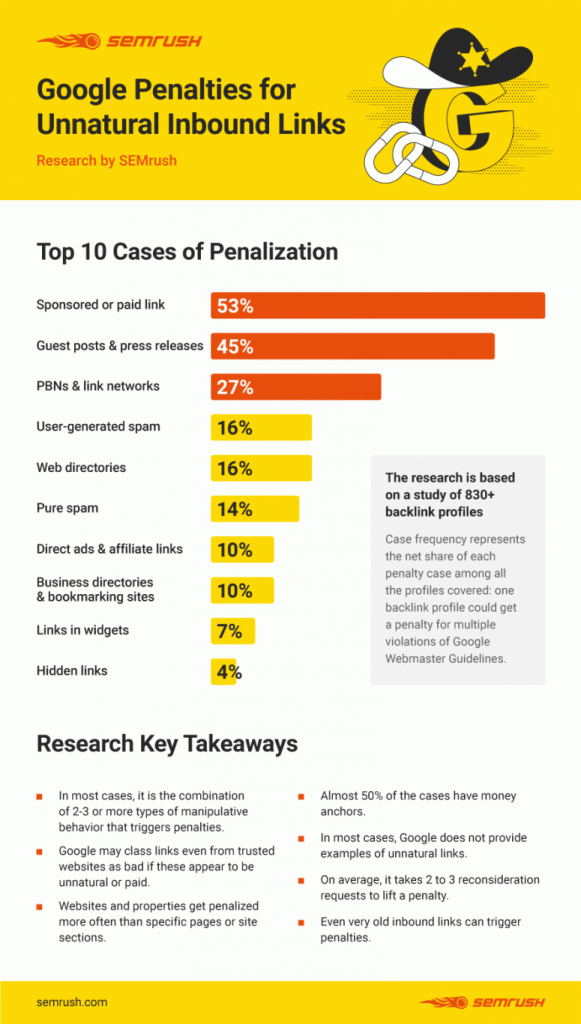
Want to know more about anchor text, links and SEO? I strongly advise you to read and bookmark these resources elsewhere:
- 5 things that stop anchor text being passed
- Why Exact Match Anchor Text is Bad
- Google Penalties Research: Detecting and Dealing with Unnatural Inbound Links
* (CC BY-SA 2.0) Creative Commons image by Randi Hausken

Can you clarify what you mean by “exact match”?
Exact match to the title tag of the page being linked to, or exact match to the phrase being searched for?
Bill: Exact match to the keyphrase I already ranked for.
Interesting,
So if this is true and I am not arguing it is not then the following is also true:
1. Your competitors could ‘hurt’ you by giving you a link with exact match anchor text.
2. You can kill yourself by issuing a track back to one of your blog posts which links to the post using the post title (assuming it has your exact keywords in it).
If this is true, I really wonder if those were Google’s intentions.
Mike: I think the filter that has been devised here is not as simple as that. It surely depends on several factors.
Google can easily determine that the link is a trackback or pingback.
They can also see whether the link is artificially optimized.
Btw. the Google bowling aspect seems possible, you are right. Thus I hope it doesn’t work that way.
inkodeR: Thank you for the feedback. I don’t spread FUD on purpose. I’d like to get exactly that kind of feedback from others to know whether I’m just fantasizing here or whether others have experienced this anomaly as well.
At first it seemed absurd to me getting kicked out for an anchor text link. When it happened repeatedly I wanted to check my sanity. Thus I published my of course incomplete findings.
I like to treat my blog like a personal forum. Telling others what happened and finding out what they think about it.
I’d like to prevent a situation similar to the one where nobody noticed that PageRank sculpting has stopped working “several months ago”.
Hi Tad – Few points.
Your point about Brand + KW definitely, works very well from tests we have been seeing lately.
A pattern I have seen for anchor text links is; often yes they do drop only to return ranking higher a few weeks later.
Also there are too maybe variables involved to come to that conclusion. Yes any SEO tactic will most likely br rendered useless once abused, but you are saying that all websites are treated equally. This is far from the truth as you know… or are you just creating FUD on purpose ;)
@Mike: Good points! Surely, Google wouldn’t want to get in a similarly awkward position as McAfee recently, so they probably would have thought about this.
@Tadeusz:
1) To what extent did the rankings for links with exact match keywords drop?
2) Do you think this algorithm involves an age threshold, where the dampening is only applied to new links but not to existing links with exact match keywords? After all, a considerable fraction of the existing links would be affected without a threshold.
3) Do your findings also hold for links to exact match domain names, e.g. Shopping.com or Immobilien.de?
Reinier:
1) The rankings dropped at least substiantially or dissappeared almost completely. That’s why I took a closer look. It was the complete opposite of what I expected (a slight improvement).
2) Yeah, probably, I added these links and then the ranking dropped.
3) No, but I didn’t have the opportunity to see whether they are affected.
Btw. It seems Branko Rihtman of SEO-Scientist.com has been experiencing similar issues and even knows how to deal with the filter.
http://twitter.com/neyne/status/15165631486
I am wondering what is Google´s idea behind this…
If a site ranks well for a phrase and more sites link to it “organically” with the same phrase out of coincidence, would that alone be recognized as “punishable” SEO?
Could this come to a point where a well-linked site does not link at all for good keywords, because sites link to it with those anchors?
btw: the oldest example for millions of exact match anchors still ranks well:
Ff you search for “here”, Adobe still ranks very high up!
@david, your example of Adobe does not apply here as ‘here’ is not an ‘exact match’ keyword adobe is trying to rank for as evidenced by it not appearing in the title tag.
I suppose anchor-text using a single keyword might get punished more than anchor-text using a small phrase including this same keyword
I’ve read that spreading out your keywords in small phrases is a better and more sustainable technique
On the other hand I see a competitor with a low pagerank (just as a quick reference) scoring only on this one keyword because he added it to a free Joomla template … I always assumed the crappy sites who use those templates would get him a penalty, but so far it seems pretty consistent
This could be really bad for your site as Mike Belasco points out. I’ll have to study this myself as it seems a bit confusing to me. Perhaps I’m a little foggy on what “exact match anchor text links” would be but I’ll spend some time on my own site and see what happens. Maybe I’ll in over my head with the SEO thing.
I’ve seen similar behavior on smaller sites with somewhat homogeneous link profiles. IMHO, sites with diverse link profiles should not experience this effect.
@Mike Belasco: I was referring to onreacts definition in the comment : Exact match = “Exact match to the keyphrase I already ranked for.”
Following this definition, the Adobe example would apply, no?
I wasn’t aware of that before but now that I know it, Ill make sure that google will never downrank my site.
Misha: Yes, this is a good point. Same here.
It would make sense if you think about it – the more trustworthy a link is, the less likely it would contain anchor text :)
That is true. Many think that meta keyword tags aren’t a positive ranking factor. But we don’t have proof for this. Even i felt the same.
I’ve had a bunch of exact match .com’s get slammed in the last week or so. Were ranking quite well with little effort but now propping up the SERPs for a search on their respective exact match.
Most of them have exact match and a single sitewide footer link to / that matches the title tag. Most also have an exact match link to / from within content of an internal page or two. Onpage is pretty light-on, unique content, no keyword stuffing etc.
Not to suggest there aren’t plenty of other reasons why they’d get punished but I wonder if this isn’t the most likely reason for them being filtered.
oops.. “Most of them have exact match”
in the title tag
The problem Google faces is that they only have so many ranking factors to work with and give weight to, so they have to constantly make choices to keep ahead of the crowd of people like us.
Google is just making sure that fair play is practiced in SEO. SEO spam methods can be quite a problem.
Personally, this is very good bit of info for me since I have always insisted upon using smartly placed anchor text and not stand-alone links. However, this does lead the temptation of using too much anchor text at the risk of disrupting the natural flow of sentences or the appearance of the text for some folks…
A solid post on an important SEO topic. Since we are always a step (or more) behind what Google is doing, blogs like these are important to keep people apprised of potential areas of concern.
Whoa! Is that for real? Maybe my blogs were trashed by Google eversince.
Hmmm, interesting. I found this myself recently, I’m new to SEO but my site was finally appearing up near the top google result for my target phrase, then in the following week I added a few links around the place with that target phrase as the anchor text (because i read that was a really good technique!)
After that, suddenly my site dropped off the first result page.. and I’m left wondering why.
Great article I agree. I had a client who did that, 90% of their links looked just too perfect targeting their keywords and as the result they lost dramatic amount of ranking.
I’ve found the best way is to diversify the anchor text of links pointing to every destination URL. I think it’s particularly important to use a combination of anchor text matching the anchor text inside one’s site navigation and anchor text that does not match one’s in-site navigation. I’m not sure how much this matters – but it seems to.
Thanks for the reply. I have diversified anchor texts but not working. The only thing I haven’t done is that in my blog, I kept using the same anchor text and sent it to corresponding page, but my goal wasn’t to trick the search engines but to help the users to learn more about it. But that keyword also happened to be my targeted keyword.
Should I contact Google?
btw just to let you know, i linked to this article from my blog sefati.net
keep up the good job
cheers
Al: I don’t think you should contact Google. That’s not a real penalty. It’s just a filter. Your backlink structure looks probably still too artificial. Try to get organic links to get a more diverse profile.
Also, thanks for the heads up in your post! You have clean, good looking blog with lots of good content. try to add a more personal note (branding) to it. Something like “AL from LA, SEO Consultant”. Don’t post as “Admin” and spice your contect up with some images. Otherwise you stay under the radar.
hey thanks for the advise…I will do that. Also the penalty is for my clients website not my website. they have a payday loan website and it is very hard to get organic links in payday loan industry. It really has no editorial values. No one wants to brag about getting a payday loan.
Google knows about this so it watches the industry closely.
Perhaps I can diversify the link building and anchor texts even more.
Hey Al, I inderstood that your client’s site has the issues but I wanted to congratulate you on your blog. I think with a little more polish it can become quite a flagship blog.
Also you can blog about any industry and there is lways a way to blog about boring topics.
Have you read my post on that?
http://seo2.0.onreact.com/how-can-websites-about-boring-topics-succeed-on-social-media
Something like the “10 Most Awful Payday Loan Stories that Really Happened”
I think Google is really fed up with all the spammer,they have no option to keep changing their algorithms. For miss use of SEO many spammed contents are getting higher rank in SERP.thank you.
This is a really interesting article,as SEO to a certain extent is theory based and without blog discussions like this verbalising your findings to others wouldn’t happen. So if your anchor text links have some variation in them, but still with the keyword included does this have the same detrimental effect?
If that’s true, everyone would spam their competitor so they will drop rank, right?
Interesting observation. I have a question though, I rank highest in my exact phrase anchor text that I use the most, but not so much for other phrases, how do you explain that?
There are scores of people who spam using keyword rich anchors and this is only obvious that google would come up with something to devalue such links. Guess the brand based anchor links hold a lot more value than keyword rich links.
I hope this thread is still open…
I used to rank #1 for “Vancouver Movers” on both Google.ca and Google.com
But now a whole bunch of new sites with less link popularity are beating me…
Did I over optimize? Am I repeating my keywords to often in my links?
Any input would be much appreciated. The website in question is:
http://www.vincentmoving.com
I live in Thailand now and don’t own any trucks anymore…I make my living with this site so it’s pretty important for me ;)
This more recent blogpost seems to strengthen your suggestion: http://searchenginewatch.com/3641002
It analysis a few top 10 rankings with the used anchor texts on the websites.
I’m a believer in filters, so your post makes sense. But I would guess that it would take several identical links to trip the filter. You wrote, “It happened both with one link added or with lots of.” So just one single link did it? Wow…
I’m also thinking this might be a temporary dampening. Have you done any testing since then to see if after a week or two your ranking recovers?
It’s a good research.
It mean that, an anchor Text contain keyword phase is better than only exact keyword, right?
For example:
Online Marketing vs Online Marketing – the best online Method
Which is better or both are the same?
Many thanks
Rich
Your conclusion makes good logical sense. We all know that Google constantly refines their algorithim to spot pandering, so this must be another of their attempts.
thanks for this info, but does it mean no more keywords or google just track keywords from post?
I’ve seen similar behavior on smaller sites with somewhat homogeneous link profiles. IMHO, sites with diverse link profiles should not experience this effect.
Good catch here. I think it is safe to say that 2 years later the thought that anchor text has been rendered just about useless is pretty widespread. We have seen as of late that it varies by sector, and even location or in other words – SERP competition.